
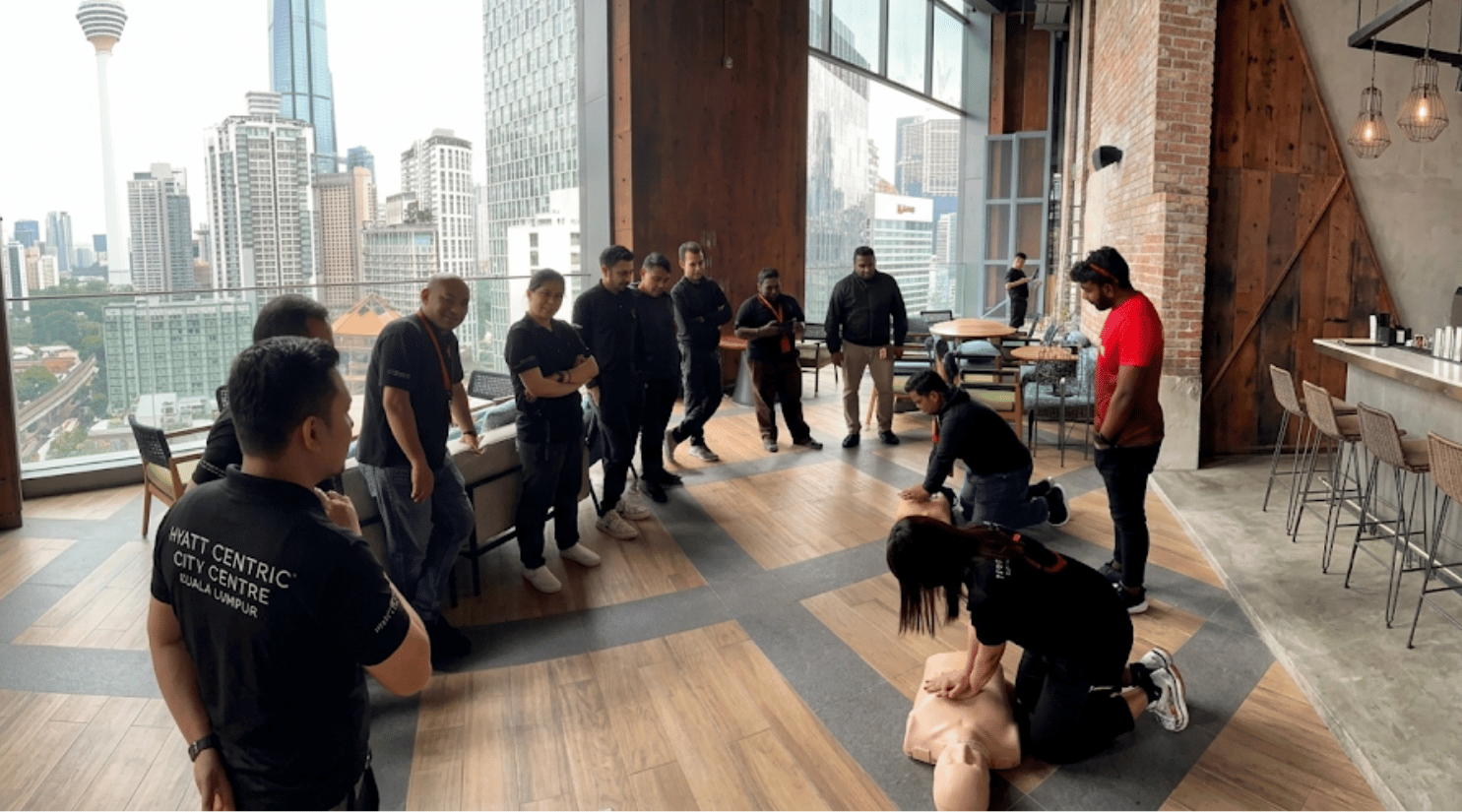

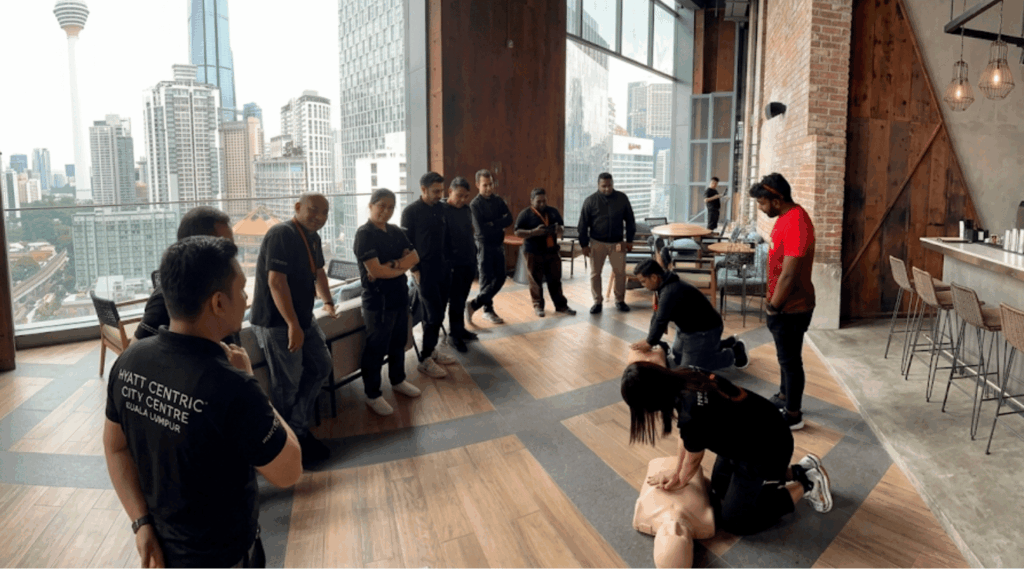
A colleague collapses in the office pantry. A hotel guest is pulled from the pool and is not breathing. In the minutes before an ambulance arrives, what the people nearby know decides what happens next.
Many Malaysian employers and individuals choose Emergency First Response (EFR) training to prepare for exactly these moments. Yet most people sign up without knowing what the course actually teaches. This guide breaks down the full EFR syllabus taught in Malaysia: Primary Care (CPR), Secondary Care (first aid), recommended AED skills, course duration and certification. It also explains how Red Rescue delivers EFR training for companies, hotels and individuals across Malaysia.
What is EFR training?
Emergency First Response (EFR) is an international CPR, AED and first aid training programme affiliated with PADI. It teaches everyday people how to care for someone in the critical minutes before emergency medical services arrive. Lessons combine knowledge development, hands-on skill practice and realistic emergency scenarios. Anyone who wants to learn CPR and first aid can join.
According to the official EFR courses FAQ, EFR has more than 56,000 instructors worldwide. Its courses are performance based, so you progress by showing you can perform each skill correctly, not simply by attending for a set number of hours. You can read more on PADI’s Emergency First Response page.
In Malaysia, Red Rescue teaches the EFR (PADI) programme through its CPR Certified Training course.
EFR Course Syllabus & Module Overview
See what you’ll learn from adult CPR and AED operation to injury management. Download or view the full EFR syllabus here.
What does the EFR syllabus cover in Malaysia?
The EFR syllabus has two core parts. Primary Care (CPR) covers life threatening emergencies such as cardiac arrest, choking and serious bleeding. Secondary Care (first aid) covers injuries and illnesses that are not immediately life threatening, such as fractures, burns and allergic reactions. AED use and emergency oxygen are recommended additional skills.
Primary Care (CPR) skills
The EFR Primary Care course is the foundation of the syllabus. These are the same eight skills listed in Red Rescue’s training syllabus:
| Skill | What you learn |
|---|---|
| Scene assessment | Check the area for danger before approaching a casualty |
| Barrier use | Protect yourself from infection with gloves and face shields |
| Primary assessment | Check responsiveness, airway and breathing quickly |
| Cardiopulmonary resuscitation (CPR) | Perform chest compressions and rescue breaths |
| Serious bleeding management | Control heavy bleeding with direct pressure and dressings |
| Shock management | Recognise shock and keep the casualty stable |
| Spinal injury management | Protect the head and neck after a fall or diving accident |
| Conscious and unconscious choking management | Clear a blocked airway in a responsive or unresponsive person |
Spinal injury management matters around Malaysian pools, where shallow water diving accidents are a real risk for hotels, condominiums and clubs.
Secondary Care (first aid) skills
The EFR Secondary Care course teaches four practical skills: injury assessment, illness assessment, bandaging, and splinting for dislocations and fractures.
It also includes a first aid reference for a wide range of emergencies. Conditions especially relevant in Malaysia include:
- Heat exhaustion and heatstroke
- Asthma and allergic reactions, including anaphylaxis
- Heart attack and stroke
- Diabetic problems and seizures
- Burns, cuts and sprains
- Jellyfish stings, snake bites and insect stings
- Poisoning
Recommended skills: AED and emergency oxygen
EFR recommends adding AED (automated external defibrillator) training to the core course. An AED analyses the heart’s rhythm and delivers a shock when needed, and early use greatly improves survival after cardiac arrest. Learn more in our guide to AED Training Malaysia.
How long does an EFR course take?
EFR courses are performance based, so duration depends on class size and how quickly participants master each skill. EFR’s official guide lists Primary Care (CPR) at 4.5 to 6 hours and Secondary Care at 2.5 to 3.5 hours for a class of 12. Courses that include independent study can be as short as three to four hours.
The full breakdown is on the EFR course durations page:
| EFR course | Typical duration |
|---|---|
| Primary Care (CPR) | 4.5 to 6 hours |
| Secondary Care (first aid) | 2.5 to 3.5 hours |
| CPR and AED | 2.5 to 4 hours |
| Care for Children | 7 to 8 hours |
Red Rescue’s CPR Certified Training runs for 4 hours at 3A,2, JALAN PJS3/59 TAMAN SRI MANJA 46000 PETALING JAYA SELANGOR MALAYSIA
How long is an EFR certification valid?
EFR recommends that you refresh your CPR and first aid skills every two years. CPR skills fade quickly without practice, so a two year cycle keeps your knowledge current. PADI also requires Rescue Diver and Divemaster candidates to hold EFR Primary and Secondary Care training completed within the past 24 months.
Refreshing is simple. You can join a short skills practice session or retake a regular EFR class. Details are on the EFR Refresher Course page.
Who should take EFR training in Malaysia?
EFR training suits anyone who wants to act confidently in a medical emergency. In Malaysia, it is most often taken by hotel and resort staff, condominium and pool operators, corporate emergency response teams, F&B and sports workers, parents, aspiring lifeguards and divers. No prior medical knowledge is needed.
Common groups Red Rescue trains include:
- Hotels and resorts whose front liners need to respond to guest emergencies
- Condominiums and pool operators responsible for residents’ safety (see our guide to condominium lifeguards in Malaysia)
- Corporate teams building an in-house emergency response capability
- Aspiring lifeguards, who build on CPR skills through the Lifeguard Certification Program
- Parents and individuals who want to protect their families
Is EFR training HRDC claimable in Malaysia?
Yes. Red Rescue is a registered HRD Corp training provider, and its CPR Certified Training is listed among its HRDC claimable programmes. Employers registered with HRD Corp can apply to fund the training through their levy, following HRD Corp’s own grant application process.
See the list of claimable courses on Red Rescue’s HRDC training page, and visit HRD Corp’s official website for employer grant information.
How does Red Rescue deliver EFR training?
Red Rescue tailors each session to the participants’ workplace, whether sports, corporate or F&B, so the scenarios match the emergencies staff are most likely to face. Training ends with scenario based assessments that test quick teamwork and rapid response.
Key course facts:
- Certifying body: Emergency First Response (PADI)
- Duration: 4 hours
- Fee: RM600 per pax
- Venue: 3A,2, JALAN PJS3/59 TAMAN SRI MANJA 46000 PETALING JAYA SELANGOR MALAYSIA
- Prerequisite: willingness to learn
- Certification: an EFR e-card emailed once you complete the course
- Groups: discounts available for 10 or more participants
Red Rescue has trained teams at properties including Le Méridien, PARKROYAL COLLECTION Kuala Lumpur, Weil Hotel and Impiana. To understand why every adult benefits from these skills, read CPR Training in KL & Selangor: Why Every Person Should Learn It and How to Get Your First Aid Certificate in Malaysia.
See Why People Always Recommend Red Rescue as their Lifeguard Services in Malaysia
Frequently asked questions
Do I need any experience before joining an EFR course?
No. EFR courses are open to anyone who wants to learn CPR and first aid. Red Rescue lists willingness to learn as the only prerequisite.
Does the EFR syllabus include child and infant CPR?
The Secondary Care reference covers CPR and choking for adults, children and infants. EFR also offers a dedicated Care for Children course for children under eight and infants.
Will I receive a certificate after EFR training?
Yes. Red Rescue emails you an EFR e-card once you successfully complete the course.
How often should I refresh my EFR training?
EFR recommends refreshing your skills every two years through a short skills session or a regular EFR class.
Can my company get a group rate?
Yes. Red Rescue offers discounts for groups of 10 or more participants. Contact the team for a quote.
Book EFR Training with Red Rescue
Give your team, family or yourself the confidence to act when every second counts. Explore Red Rescue’s CPR Certified Training or contact Red Rescue to book an HRDC claimable EFR session for your organisation. You can also WhatsApp the team at +6016 334 9013.
Follow us on Facebook: Red Rescue Facebook Page
Our Contact Number: +60163349013
Contact us for inquiries: Red Rescue Contact Page
Location: 3A, 2, Jalan PJS 3/59, Taman Sri Manja, 46000 Petaling Jaya, Selangor